Cast: Ayushmann Khurrana, Sara Ali Khan, Rahul Bose, Gulshan Grover, Ram Kapoor, Mukul Dev
Director: Aakash Kaushik
Bollywood’s obsession with espionage thrillers has historically oscillated between two extremes: heavy-handed jingoism or grit-and-glam action. In his debut feature Udta Teer, writer-director Aakash Kaushik attempts a completely different trajectory. He tries to push the envelope by blending cross-border tensions with amnesiac, mistaken-identity farce. The result is an incredibly creative but ultimately uneven cinematic exercise that starts out as a refreshing satire before buckling under the pressure of mainstream commercial expectations.
The Story and Script: A Genius Logline Fractured by Tonal Shifts
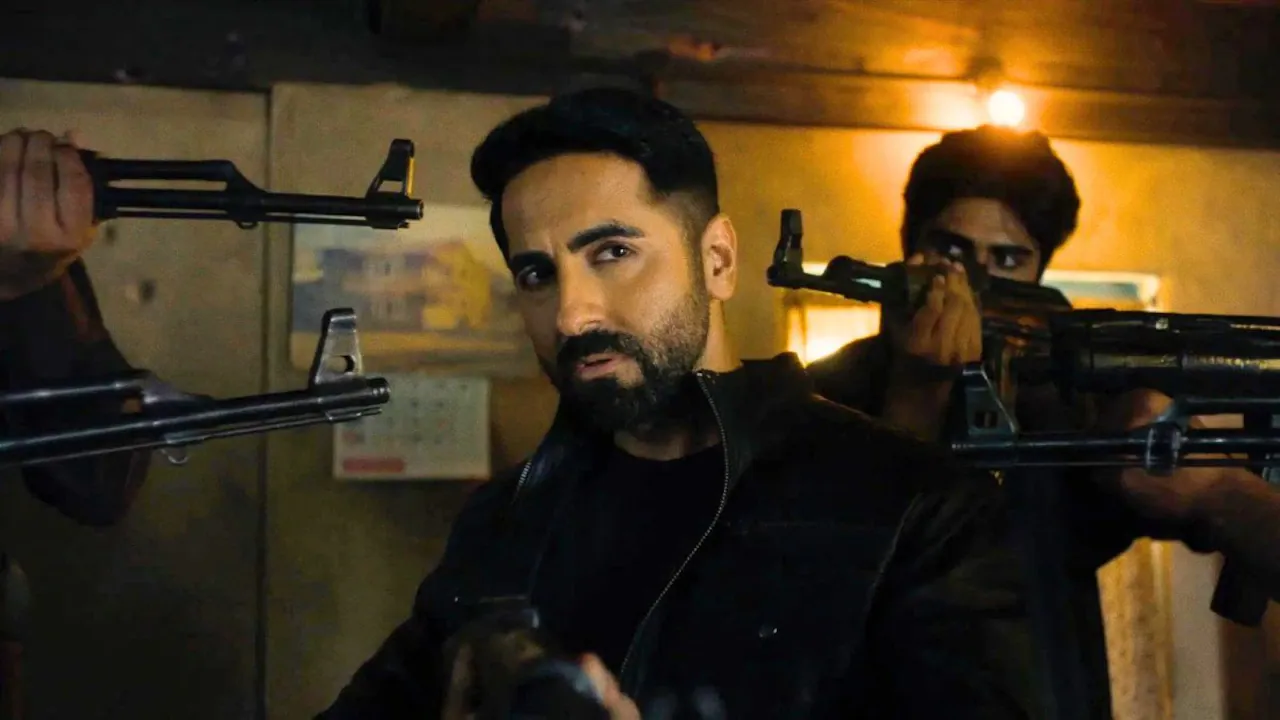
On paper, the narrative hook is pure genius: Bilal Ahmed (Ayushmann Khurrana), an elite Pakistani ISI agent, has successfully infiltrated India’s Counter-Terrorism Squad (CTS) under the alias ‘Vikrant Thapar’. Before his handlers can execute their plans, a catastrophic blast leaves Bilal with post-traumatic amnesia. Stripped of his original identity but possessing an institutionalised sense of duty, Bilal wakes up genuinely believing that he is an ultra-patriotic Indian CTS officer.
The screenplay excels in its first half, operating like a deadpan mockumentary-style comedy. The comedy stems from the sheer exasperation of his fellow ISI moles who have to watch in horror as Bilal, in his newfound Indian patriotic fervor, accidentally yet ruthlessly dismantles his own agency’s networks. Kaushik handles this “identity in a haze” setup with subversiveness, poking fun at the bureaucratic and administrative absurdities on both sides of the border.
However, the script suffers a major fracture in the second half. Rather than leaning into the dark comedy or exploring the deeper philosophical question—whether national identity is tied to memories or our immediate choices—the movie halts its momentum to appease the multiplex gallery. It forces in subplots of domestic melodrama, a romance track featuring a significantly underutilized Sara Ali Khan, and an abruptly serious patriotic tone that clashes harshly with the lighthearted farce established early on.
Also Read : PRAHAAR Movie Review https://bollywoodmonk.com/prahaar-movie-review-rajkummar-rao-holds-court-in-a-gritty-yet-flawed-legal-drama/
Direction and Performances: Quirky Casting Anchors the Ship
Kaushik’s direction shows distinct promise, especially in his subversion of standard spy tropes. Instead of conventional action stars, he populated the narrative with a cast unassociated with slapstick, yielding surprisingly great results.
Ayushmann Khurrana handles the duality of Bilal/Vikrant seamlessly, striking a balance between wide-eyed confusion and frantic conviction. Rahul Bose delivers a standout performance as the intensely serious, clueless CTS chief, while the late Mukul Dev anchors the comedic villainy with great presence. Unfortunately, the narrative’s transition into broader caricatures and forced gags later on drags down what could have been a tightly spun geopolitical farce.
The India-Pakistan Angle: Nuance Lost to Stereotypes
Unlike conventional Bollywood spy vehicles that actively demonise the neighbour, Udta Teer initially chooses humanisation through shared absurdity. The dialogue plays heavily on meta-references, highlighting how both nations rely on similar nationalistic rhetoric to feed their populations.
However, the movie doesn’t entirely break free from systemic tropes. To ensure it remains palatable to mainstream domestic audiences, the Pakistani handlers (played by Gulshan Grover and Ram Kapoor) are written with a cartoonish incompetence, relying on outdated cliches like an obsession with biryani and pulao. It plays it safe when it matters most, dropping its boundary-pushing premise to fall back onto traditional, secure patriotic resolutions.
Controversies: International Bans and Diplomatic Friction
The sensitive nature of the film’s premise resulted in swift international pushback just days before its October 23, 2026 release.
Nepal’s Central Film Censor Board officially banned the public screening of Udta Teer.
The ban was enforced under Section 8(3) of Nepal’s National Cinema Act, which empowers authorities to restrict content that could potentially harm ties with friendly nations. Nepalese authorities determined that the film’s explicit satire regarding India-Pakistan intelligence warfare was too politically sensitive and risked violating regional diplomatic harmony. The decision left the filmmakers disheartened, with director Aakash Kaushik publically voicing his shock and stating that the movie aimed for lighthearted unity rather than regional malice.
Box Office: A Slow Start Saved by a Second-Weekend Resurgence
Produced under the banners of Dharma Productions and Sikhya Entertainment on an estimated budget of ₹50 crore to ₹65 crore, Udta Teer faced a challenging start. It debuted with a modest opening day net collection of ₹4.10 crore in India, hindered by minimal pre-release hype and stiff theatrical competition from concurrent regional releases.
However, positive word-of-mouth regarding its first-half comedy kept the film alive. By its second weekend, the movie registered a notable 40.4% jump on its second Saturday, pulling in ₹4 crore net in a single day. After nine days in theatres, the worldwide gross box office collection for Udta Teer stands at ₹55.53 crore, with ₹45.03 crore coming from domestic gross and ₹10.50 crore pulled from overseas markets. While the film has managed to cross the lower tier of its production budget, its long-term profitability will rely strictly on holding its theater occupancy through the weekdays.
The Verdict
Udta Teer is an ambitious misadventure. It is highly watchable for its incredibly sharp first hour and excellent ensemble performances, but it ultimately lacks the cinematic courage to fully commit to its own satirical bite.